Leadership Traits
Prior to the early 20th century, the “great man” theory was generally accepted, summarized as the great leaders (in the timeframe mostly men) were born not made. Then came leadership traits theory.
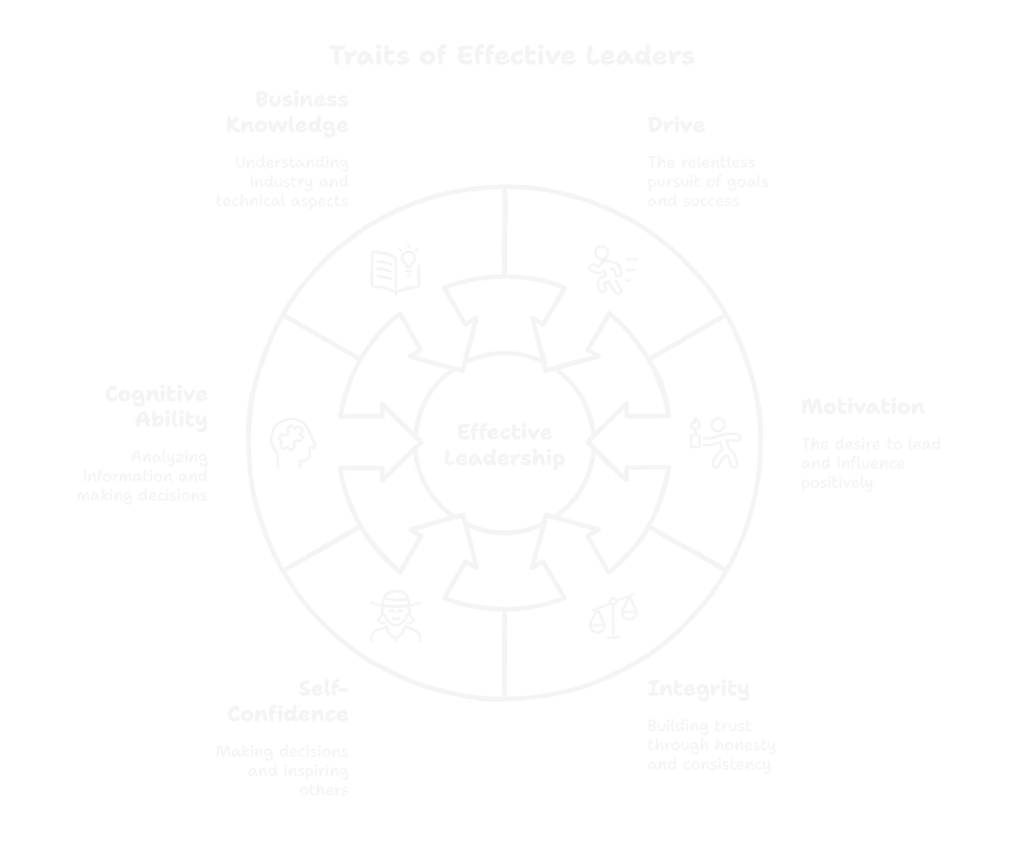
Kirkpatrick and Locke argued that traits do matter, laying out six core traits that leaders exhibit:
- Drive: This includes high achievement, motivation, ambition, energy, tenacity, and initiative. Leaders are proactive and persistently pursue goals.
- Leadership Motivation: A strong desire to lead and influence others is crucial, but the most effective leaders have a socialized power motive, using power to benefit the organization rather than for personal gain.
- Honesty and Integrity: These are fundamental for building trust with followers. Leaders must align their words with their actions.
- Self-Confidence: Leaders need self-confidence to make decisions, overcome setbacks, and inspire followers. They also tend to be emotionally stable, exhibiting even temperament.
- Cognitive Ability: Leaders require strong analytical skills and good judgment to process information and make effective decisions.
- Knowledge of the Business: A deep understanding of the company, industry, and technical aspects is necessary for making well-informed decisions.
The Leaders Field Guide aligns with Kirkpatrick and Locke , meaning leaders do exhibit specific traits. Adding that it is important to recognize that these traits will be more or less developed based on the stage of the leader’s journey. While some traits may be less trainable, knowledge and self-confidence can be developed. Honesty is a matter of choice.
While effective leaders possess a combination of traits, traits alone are not sufficient for effective leadership. Leaders also need skills, vision, and the ability to implement their vision.
Practical Application
Selecting leaders for your team can be difficult. This is true whether you are assessing an external candidate’s leadership potential from a series of interviews, or an internal candidate incorporating performance feedback and observations.
Approaching either scenario with the leadership traits in mind, you can craft questions that may provide insights into the candidate’s leadership potential, or where they are at on their journey. Keeping in mind that traits are not all that is necessary for a leader.
An example would be to ask “How do you handle difficult situations when you find yourself becoming irritated, or even angry?” From my experience, the answer will shed light on both even temperament, and honesty.
For example:
Candidate 1 Answers: “I don’t get angry”
Candidate 2 Answers: “I take a pause, or deep breathe, and if needed I step away and circle back when I have a clear mind”
Which one of these seems more honest, and demonstrates emotional intelligence?
Bottom line is human nature is complicated. Trying to assess someone’s leadership traits based on an interview is not foolproof. You will only truly see the traits exhibited, or not, as time passes.
Reference:
Kirkpatrick, S. A., & Locke, E. A. (1991). Leadership: Do traits matter? Academy of Management Executive, 5(2), 48–60. https://aom.org/membership/join